Who Sang Song Called Twisting Again
Essay
"The Twist," an early on 1960s dance hit by Philadelphia vocalizer Chubby Checker (real name Ernest Evans, b. 1941), ushered in a new way of dancing and solidified Philadelphia's role every bit a major trendsetter in pop music in this catamenia. Released in the summer of 1960 by Philadelphia-based Cameo Parkway Records, "The Twist" reached number one on the pop music charts on two split occasions, in 1960 and 1962, the merely non-holiday vocal ever to exercise so.
Checker'due south recording of "The Twist" was a cover of the original by Hank Ballard and the Midnighters. Ballard (real name John Henry Kendricks, 1927–2003) had enjoyed success on the rhythm and dejection charts in the 1950s, particularly with songs with risqué lyrics. His version of "The Twist," recorded in late 1959, was gaining popularity in 1960, simply Dick Clark (1929–2012), host of the popular and influential teen music and dance TV show American Bandstand, broadcast nationally from Philadelphia, considered it too suggestive for mainstream audiences. At Clark's urging, Cameo Parkway recorded its own version of "The Twist" with xix-year-former Chubby Checker on vocals. While both Ballard and Checker were African American, the tastemakers at American Bandstand and Cameo Parkway considered Checker—young, cheerful, and wholesome looking—more palatable for a broader audience than Ballard.
Trip the light fantastic toe tunes with the word "twist" in the championship or whose lyrics described a twisting dance motility (oftentimes as a sexual double entendre) began to appear in early on twentieth-century African American popular music and dejection and were adequately mutual by midcentury. Information technology was standard practice in Black music of this period for bits of melodies and lyrics with origins in the African American vernacular tradition to broadcast among performers and to notice their way into dissimilar songs. With no known creator, record companies oft gave writing credit to the artist who that start put these musical elements on record.
Such was the case with "The Twist." While Hank Ballard is credited as the songwriter, the song's origins are in gospel and rhythm and blues. Gospel singer and guitarist Joseph "Jo Jo" Wallace (b. 1926) had the original idea for a song with the lyrics "Come on babe, allow's practise the twist" based on a trip the light fantastic toe he remembered his sister doing as a child in his native North Carolina. Wallace was a member of the Sensational Nightingales, ane of several popular gospel groups based in Philadelphia in the mid-twentieth century whose members had migrated from the South. Wallace and some other member of the group, Nib Woodruff (Willie George Woodruff, c. 1929–95), developed the vocal, but they did non consider it appropriate for their gospel grouping, and in the mid-1950s they began shopping information technology to rhythm and blues artists. One was Philadelphia singer Piddling Joe Cook (1922–2014) of Little Joe & The Thrillers. Cook fabricated a demo recording of "The Twist," but his record company opted not to record it. Former around 1957, the Sensational Nightingales offered the song to Hank Ballard and the Midnighters while both groups were staying at the same hotel in Tampa, Florida. Ballard and guitarist Cal Light-green (1937–2004) rearranged the song into a twelve-bar blues and the group recorded it in Nov 1959 for their record label, King Records, based in Cincinnati, Ohio.
Accounts vary as to how "The Twist" first came to the attending of Dick Clark, but sometime in early 1960 he told his friend, Cameo Parkway owner Bernie Lowe (real name Bernard Lowenthal, 1917–93), that Ballard's record was catching on and he needed a less suggestive version to play on Boob tube. Cameo Parkway chose to do a encompass by Ernest Evans, an aspiring Southward Philadelphia singer known for his talent for impersonating other vocalists. Previously, in late 1958, when Clark had asked Cameo Parkway to brand a singing Christmas card that he could send out equally a holiday greeting, the company had Evans record impersonations of popular artists singing "Jingle Bells." Information technology was during rehearsals for this Christmas record that Ernest Evans became "Chubby Checker." Dick Clark's wife, Barbara (b. 1930), heard Evans, who was a bit butterball at the fourth dimension, mimicking singer and pianist Antoine "Fats" Domino (b. 1928) and, in a play on "Fats Domino," she christened him "Stubby Checker." Cameo Parkway followed up Checker's 1958 singing Christmas greeting by having him record "The Form," a novelty tape in which he mimicked various stone and roll artists singing "Mary Had a Little Lamb." "The Course" was a minor hit in 1959 and paved the way for Checker's cover of "The Twist."
Chubby Checker's version of "The Twist," recorded in June or July 1960, was almost an verbal copy musically of Hank Ballard's, only with heavy promotion by Cameo Parkway and Dick Clark, both hit-making machines in this flow, it became a boom hit. Dick Clark had 2 national Boob tube shows at this fourth dimension: American Bandstand, his daily weekday prove from Philadelphia, and The Dick Clark Evidence, a Saturday night program broadcast from New York City. Clark began playing Checker's version of "The Twist" on American Bandstand in the summer of 1960 and then had Checker appear in person on The Dick Clark Show on August half-dozen, 1960, to lip-synch and dance to it. The record went to number one on the popular charts that September and spawned a craze that forever changed the style people danced.
Prior to "The Twist," most dancing was done past couples who executed their steps while holding one another as partners. "The Twist" fundamentally changed this, ushering in a new "open" type of dancing in which people danced apart, non touching. "The Twist" became a huge trip the light fantastic craze in the early 1960s, cut across generational and class lines, expert by teenagers and adults, from the working class to the social aristocracy. Other record companies cashed in by putting out their ain twist records, and Chubby Checker had follow-up top ten hits for Cameo Parkway with "Permit'southward Twist Again" in 1961 and "Ho-hum Twistin'" in 1962, the latter a duet with singer Dee Dee Sharp (existent proper noun Dione LaRue, b. 1945). In between these hits, his original 1960 recording of "The Twist" shot support to number one in Jan 1962. "The Twist" also launched Cameo Parkway's period every bit a national trendsetter in teen dance music, with trip the light fantastic hits such every bit "Mashed Potato Fourth dimension," "The "Watsui," "The Bristol Stomp," and many others in the early 1960s. By this time "The Twist" had entered the mainstream, becoming part of American pop culture and a longtime staple at dances, weddings, and parties.
Jack McCarthy is a music historian who regularly writes, lectures, and gives walking tours on Philadelphia music history. A certified archivist, he recently directed a major project for the Historical Society of Pennsylvania focusing on the archival collections of the region'southward many small historical repositories. Jack serves every bit consulting archivist for the Philadelphia Orchestra and the Mann Music Center and worked on the 2022 radio documentary Going Blackness: The Legacy of Philly Soul Radio. He gave several presentations and helped produce the Historical Society of Pennsylvania's 2022 Philadelphia music series, "Memories & Melodies." (Writer data current at time of publication.)
Copyright 2017, Rutgers University
Gallery
Teenagers Do "The Twist"
Library of Congress
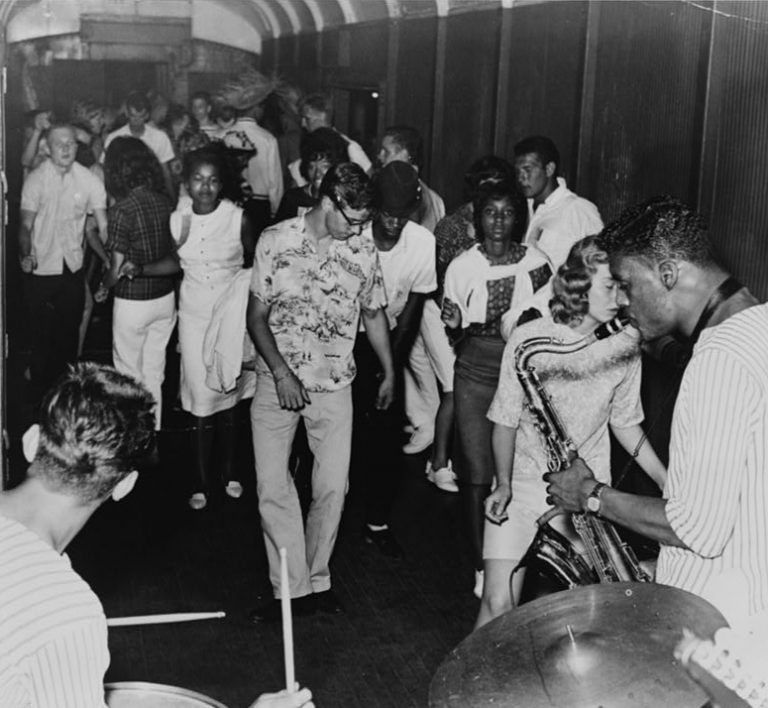
Before "The Twist," most dancing was done by couples who held each other as partners while they danced. "The Twist" ushered in a new type of dancing in which people did not affect while executing steps. The high schoolhouse students in this 1962 photograph are doing "The Twist" in the luggage auto of a train.
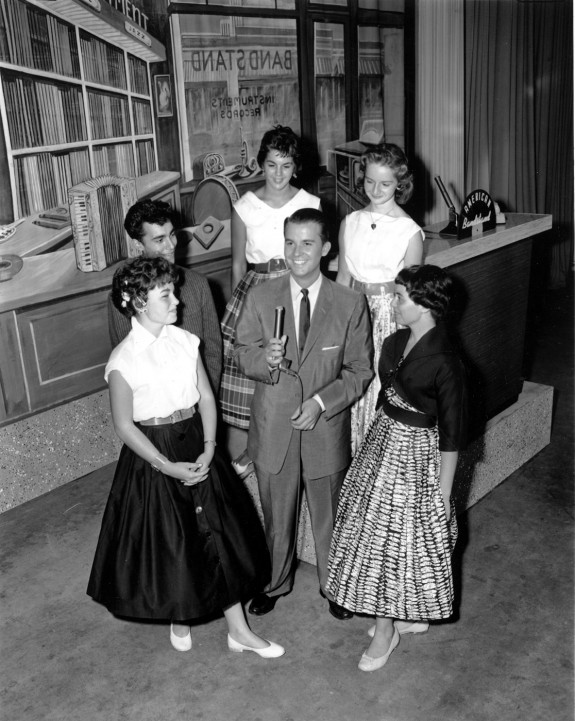
Dick Clark on American Bandstand
Special Collections Inquiry Center, Temple University Libraries
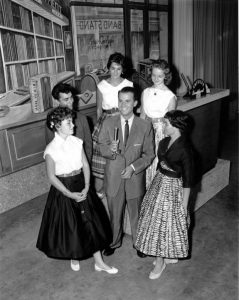
Stubby Checker's recording of "The Twist" was popularized past Dick Clark, who promoted the vocal on his popular television receiver shows, American Bandstand and The Dick Clark Show. It was Clark who suggested that Cameo Parkway record a new version of the song, which led to Checker's hit version.
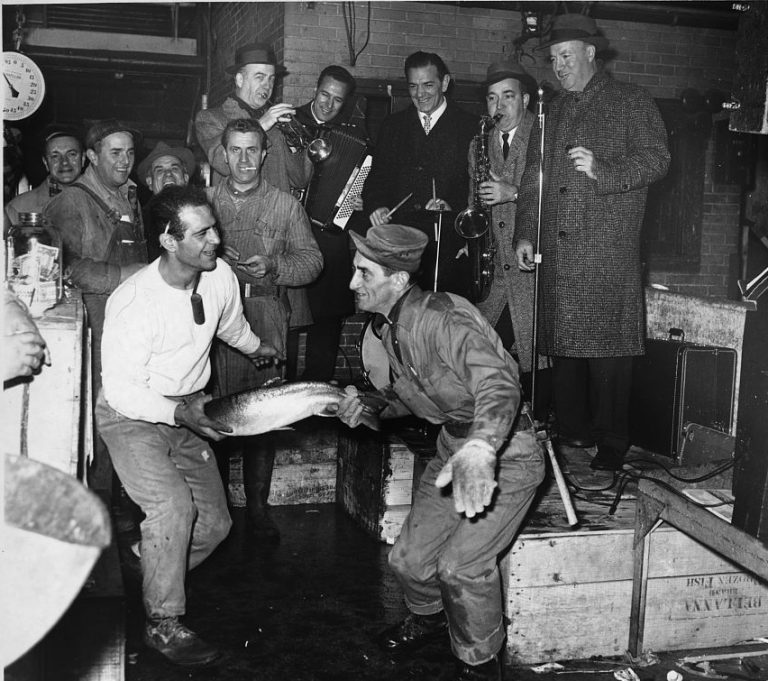
Twisting with a Fish
Library of Congress
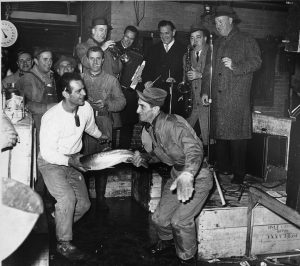
"The Twist" was a dance craze that transcended age and grade lines. This 1962 photograph shows fish mongers dancing "The Twist" to entertain customers at the Fulton Fish Marketplace in New York City.
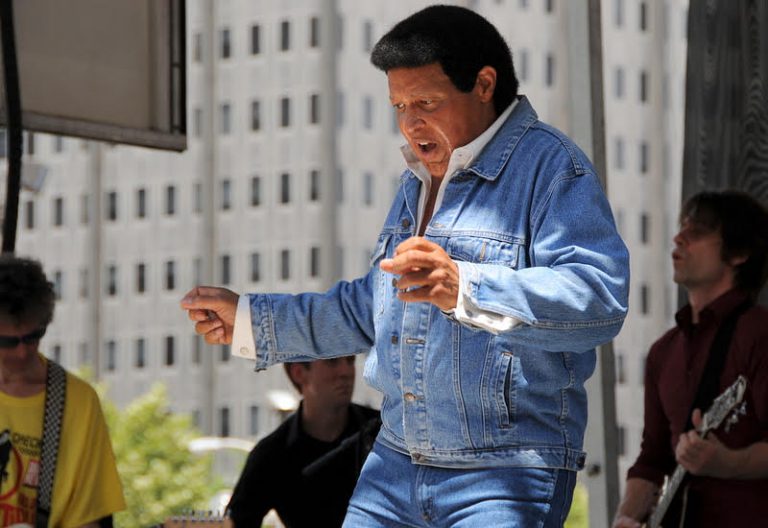
Chubby Checker Dancing "The Twist"
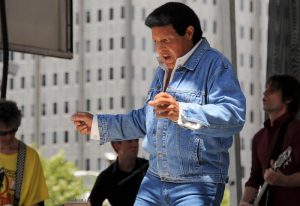
Chubby Checker does "The Twist" on July 9, 2010, exterior Philadelphia City Hall, where the singer helped gloat the fiftieth ceremony of the trip the light fantastic.
(Photograph by Donald D. Groff for The Encyclopedia of Greater Philadelphia)
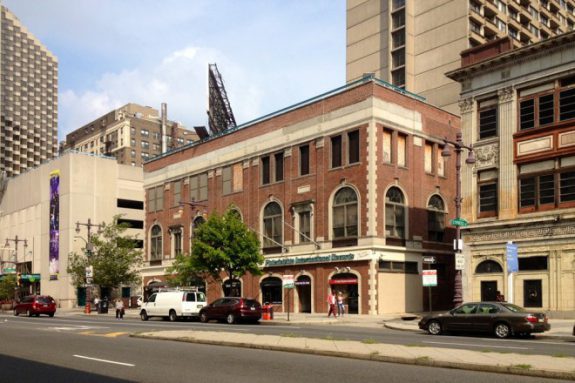
Cameo Parkway Records
Subconscious City Philadelphia
"The Twist" was recorded by Chubby Checker for Cameo Parkway Records. The company was founded as Cameo Records in 1956 by Bernie Lowe and Frank Mann and joined by the subsidiary Parkway Records in 1958. Both labels operated out of this headquarters on South Broad Street. "The Twist" was Parkway's first major single and started a dance craze beyond the nation. While both labels institute success in the 1960s with hits by Checker, Bobby Rydell, and others, it was not enough to keep them solvent. In 1967, Cameo Parkway was sold and moved to New York under the proper name Abkco Records. The Cameo-Parkway building was later occupied by another local tape characterization, Kenneth Gamble and Leon Huff's Philadelphia International Records, which was founded in 1971. The building was demolished in 2016.
Backgrounders
Links
- "The Twist" by Hank Ballard & the Midnighters (YouTube)
- "The Twist" by Chubby Checker (YouTube)
- "The Grade" by Chubby Checker (YouTube)
- "Let'southward Twist Again" by Chubby Checker (YouTube)
- "Dull Twistin" by Chubby Checker (YouTube)
- Dance Demonstration of The Twist (1961, YouTube)
Source: https://philadelphiaencyclopedia.org/essays/twist-the/
0 Response to "Who Sang Song Called Twisting Again"
Enregistrer un commentaire